Winefield & Associates
  • Home
  • Investment Criteria
  • About The Founder
  • Press
    • NY Times Article
    • LABJ Article
    • Propmodo Article
    • Commercial Property Executive Article
    • Western Real Estate Business Article
    • California City News Article
    • The Sacramento Bee Article
    • California Globe Article
  • Updates
  • Podcasts
  • VI Blog
  • Contact

California Vapor Intrusion Blog

This California Vapor Intrusion (VI) Blog provides updates on CalEPA’s rule development process associated with increasing attenuation factors (AFs) for volatile organic compounds.  Winefield & Associates contends that the proposed new AF standard of 0.03 is neither scientifically sound nor necessary.  As such, the blog will provide scientific and regulatory data with the goal of developing sane VI criteria that remain protective of human health while not thwarting California development, especially as California experiences a severe housing shortage. 

Inside CalEPA’s 2025 Vapor Intrusion Workshop: 10 Big Insights

8/18/2025

1 Comment

 
Picture
CalEPA spearheaded a virtual vapor intrusion workshop on July 24, 2025.  There were about 300 attendees, and the workshop took place over three hours.  The four workshop PowerPoint presentations are linked here, and 10-point summary of the workshop is provided below:
 
  1. Strong multi-agency collaboration – The CalEPA Vapor Intrusion Workgroup, active since 2014, continues to align State Water Board, DTSC, OEHA, and other agencies on policy, training, and technical guidance.
  2. Updated guidance & training – The Supplemental Vapor Intrusion Guidance (Feb 2023) was rolled out alongside internal staff training and public video resources, with a focus on consistency and transparency.
  3. Path to closure strategies – Early scoping meetings, robust conceptual site models, and timely responses to agency comments were highlighted as key to overcoming project delays.
  4. California-specific data development – A major effort is underway to build a state-specific vapor intrusion attenuation factor dataset, informed by consultant, regulator, and public input.
  5. Partner panel insights – Developers, advocates, and academics called for earlier regulator involvement, interim remedies, mitigation cost guidance, and more predictable permitting timelines.
  6. Equity and climate considerations – Panelists stressed balancing environmental protection with housing equity and climate goals to avoid pushing development into unsafe or high-carbon areas.
  7. Community-level solutions – Experts urged a shift from building-by-building fixes to broader, community-scale strategies, factoring in social dynamics that affect data collection and trust.
  8. Consistent breakout session themes – Participants prioritized clearer conceptual site model expectations, more plain-language outreach in multiple languages, funding for community engagement, and consistent attenuation factor use.
  9. Technical and procedural needs – There were calls for improved data accuracy, updated databases, consistent long-term monitoring approaches, and alignment between DTSC and Water Board screening levels.
  10. Commitment to ongoing dialogue – Agencies pledged continued flexibility, recurring technical sessions, and integration of stakeholder feedback to improve vapor intrusion assessment and mitigation across California.

2025-7-24 CalEPA VI Workshop Introduction.pdf
2025-7-24 CalEPA VI Workshop-Path to Closure.pdf
2025-7-24 CalEPA VI Workshop-VI Attenuation Factor Database.pdf
2025-7-24 CalEPA VI Workshop-VI Partner Panel Presentations.pdf
--
​
About Matt Winefield
Matt  Winefield is an environmental engineer–turned–brownfield investor and the founder of Winefield & Associates. For 30‑plus years he has transformed contaminated, blighted sites into profitable infill assets through cost‑conscious remediation, creative agency negotiations, and third‑party cost‑recovery strategies. Matt partners with investors who see hidden value where others see risk. 

Learn more about Matt

Email:  [email protected]
Website:  winefieldinc.com
Phone:  (562) 618‑0037 

Connect with Matt:
LinkedIn
Brownfield Braintrust Podcast
VI Blog
About 
1 Comment

CalEPA Vapor Intrusion Workshops 2025-2026

6/27/2025

0 Comments

 
Picture
CalEPA is spearheading a series of vapor intrusion workshops to:

1) share current knowledge, tools, and strategies that CalEPA agencies are using to evaluate sites where VI may pose a potential health risk; and

2) update the public and interested parties on the agency’s efforts to collect data and case studies to potentially develop California specific attenuation factors. 

Monthly technical workshops are planned to cover such topics as: conceptual site model best practices; VI screening to site closure; collective decision making with VI partners; VI in the community; VI data in Geotracker.  The kick-off meeting will take place on July 24th at 9am. 


For more information about these workshops so you can keep your hand on the pulse of California VI practices, please visit:  CalEPA Vapor Intrusion Workshops | California State Water Resources Control Board
--

About Matt Winefield
Matt Winefield is an environmental engineer–turned–brownfield investor and the founder of Winefield & Associates. For 30‑plus years he has transformed contaminated, blighted sites into profitable infill assets through cost‑conscious remediation, creative agency negotiations, and third‑party cost‑recovery strategies. Matt partners with investors who see hidden value where others see risk. 

Learn more about Matt

Email:  [email protected] 
Website:  winefieldinc.com
Phone:  (562) 618‑0037 

Connect with Matt:
LinkedIn
Brownfield Braintrust Podcast
VI Blog
About 
0 Comments

More Bad News for California Dry Cleaner Remediation and Redevelopment Projects

6/12/2024

1 Comment

 
By Matt Winefield

California has, by far, the most stringent, overly-conservative dry cleaner subsurface remediation standards. Golden State properties will remain blighted until better science is used as is the case with 49 other States.

I spend a fair amount of time railing on California regulators about overly-conservative remediation standards that are impeding commercial and residential development. So, why stop now?! Let’s get right to it . . .

If you are trying to redevelop above a contaminated former or existing dry cleaner site in The Golden State, you are operating under the nation’s most stringent remediation standards for groundwater, soil gas, and indoor air for the primary chemical of concern, tetrachloroethylene (PCE). This data is encapsulated succinctly in the graphs below for the three media.

This data and remaining references have all been obtained from the analysis entitled: “Overview of State Approaches to Vapor Intrusion: 2023 Update,” Groundwater Monitoring & Remediation, Bart Eklund, et al. (2024). For each State, the review includes tabulations of the available types of screening values (e.g., soil gas, groundwater, and indoor air), the screening values for selected chemicals that commonly drive vapor intrusion investigations for selected volatile organic compounds, and the basis of risk levels used for cancer and non-cancer risk.

In short, for soil gas, groundwater and indoor air, California expects remediation to be completed to concentrations 2 or 3 orders of magnitude less than the vast majority of other States. The driver of most dry cleaner remediation projects is the ability to remove PCE in soil vapor. So, let’s examine the residential screening levels for shallow soil gas concentrations. (Reference Table 4 in Eklund, et al.) California has a residential screening value of 15 ug/m3. The average (mean) for the 50 states is 5,245 ug/m3. While there are some outliers, a significant majority of the states enforce shallow soil screening levels in the high 100s or low 1000s.

So, what can we conclude from this data analysis? Might it be all of the following: 1) California is the only State with brilliant health scientists and all the other States have erred; and 2) all other States are indiscriminately jeopardizing the health of its citizens; and 3) one should only live above a remediated former dry cleaner if one resides in California.

OR might we conclude: A) California regulators are wasting much-needed resources on removing residual molecules of PCE soil vapors, which scientists contend should remain in place; and B) California’s screening values are making it even more cost prohibitive to build desperately needed housing on dry cleaner and other commercial lots; and C) California regulators cannot show that their stringent standards are providing health benefits when compared to the 49 other States.

Is it 1/2/3 or A/B/C? This author contends it is A/B/C. Shame on CalEPA, SWRCB, and DTSC for impeding housing development in the face of science that relaxes PCE screening values now being mandated via the California Supplemental Vapor Intrusion Guidance Document (February 2024).
GM&R Full Report
File Size: 1484 kb
File Type: pdf
Download File

​Distribution of Lowest Residential Screening Values for PCE Across States

Distribution of lowest screening values across states
1 Comment

AEHS Conference Presentation on Vapor Intrusion

5/22/2024

1 Comment

 
AEHS Foundation Logo
​By popular demand, Winefield & Associates (W&A) is sharing its vapor intrusion presentation given on March 20, 2024, at the AEHS Conference in San Diego. Feel free to download the complete PDF version below. The March 20th attendees included approximately 150 consultants, regulators, and attorneys. The presentation outlines how the CalEPA Supplemental Vapor Intrusion Guidance (SVIG) is actually an underground regulation as defined in the California Administrative Procedure Act (APA). Notwithstanding the word “guidance” in its title, the SVIG is absolutely binding in practice. The presentation provides examples of the SVIG’s inflexibility as well as successful Office of Administrative Law (OAL) underground regulation appeals.

W&A hopes the presentation provides an outline for aggrieved (or potentially aggrieved) parties to initiate OAL appeals and lawsuits. A successful appeal would stop SVIG implementation in its tracks and mandate that CalEPA revise SVIG implementation and/or halt SVIG implementation and begin a regulatory review process. For those who would like to begin an OAL appeals process and need legal referrals, please contact Matt Winefield.

AEHS SVIG as Regulation
File Size: 2331 kb
File Type: pdf
Download File

1 Comment

CalEPA SWRCB Site Closure Rates Continue to Decline - Likely Due to Vapor Intrusion Guidance

2/26/2024

0 Comments

 
Winefield & Associates (W&A) has updated its data review of No Further Action letters (NFAs) issued by the State Water Resources Control Board and its Regional Boards. The average number of NFAs issued for the three-year period before the CalEPA Vapor Intrusion Guidance (VIG) was 701. The average number issued between 2020 and 2023 (post-VIG) was 465. This difference is a reduction of 34%. Even more dramatic is the comparison between the 2017 NFA amount of 778 and the 2023 NFA amount of 388, a 50% reduction. This NFA trend is an alarming disincentive for investors to tackle brownfield challenges in California, especially in environmental justice regions, where land values tend to be lowest.

Notes on Approach:
  1. The Draft VIG was issued in February 2020, so CY 2020 was used as the first post-VIG year.
  2. Cleanup Program Sites and Leaking Underground Storage Tank (LUST) Cleanup Sites were captured. We acknowledge that LUST sites are not supposed to be included in the VIG, but W&A’s experience indicates that the VIG has permeated all SWRCB departments.
  3. Consideration of Total Site Count Reduction: The total number of active sites at the end of 2021 was 7,226, while the total number in 2023 was 6,989. This reduction is only 3.2% over two years, which indicates a relatively stable number of active sites.
  4. Consideration of COVID: W&A believes COVID had a minimal impact on site activity, because all regulators and consultants were “essential workers” during the pandemic. No remediation mandate or guidance was set aside during COVID.
  5. Consideration of Other Regulatory Programs: W&A acknowledges that other regulatory programs (such as the USEPA Region 9 TCE short term response levels and OSWER 2015 VI guidance) could have also impacted NFA issuance rates; however, the most dramatic changes in screening level reductions and most aggressive agency response occurred due to the CalEPA VIG.

Date Summary Table:
SWRCB NFA Breakdown
File Size: 549 kb
File Type: pdf
Download File

0 Comments

The Challenges of Dry Cleaner Contamination - The Sacramento Bee Publishes Exceptional Three-Part Series

11/7/2023

1 Comment

 
An important journalistic and brownfield milestone has occurred! In October, The Sacramento Bee published a three-part series on the environmental and public health threat posed by decades of pollution from dry cleaning chemicals across California. Winefield & Associates wrote the reporter, Mackenzie Shuman, and provided regulatory and scientific solutions to outdated DTSC and Water Board policies. Maybe Ms. Shuman will add a fourth part to the series with W&A’s information.

Here’s a recap of the great articles:
  • Their eye-catching titles are “How pollution from dry cleaners left California sitting on cancer-linked ‘time bombs,’” “California’s small dry cleaners face massive bills to clean up toxic chemicals,” and “How can California help clean up thousands of polluted dry cleaning sites?”
  • Effective January 1, 2023, PCE can no longer be used in California dry cleaners.
  • 75% of dry cleaners create contamination plumes.
  • Clean up costs per site range from $1M to $10M with current regulatory policies (W&A contends that these costs could be reduced by at least 50% if the Water Boards and DTSC adopted best science).
  • Estimates to clean up all PCE-contaminated dry cleaners in California range anywhere from $7.5 billion to $100 billion.
  • Without private investment and at the current rate of state funding, it could take 220 to 2,941 years to fund the necessary remediation.
  • Some water purveyors have had to close drinking water wells that have been grossly contaminated by dry cleaner releases.
  • Many former dry cleaner buildings sit abandoned due to COVID closures and the fact that investors refuse to tackle the current environmental regulatory policies (W&A contends that these policies were unnecessarily updated between 2019 and 2023).

Download the PDFs below to read the complete articles:
Part 1
File Size: 4032 kb
File Type: pdf
Download File

Part 2
File Size: 5257 kb
File Type: pdf
Download File

Part 3
File Size: 4869 kb
File Type: pdf
Download File

1 Comment

California Environmental Agencies Just Reduced Developers’ Ability to Use Bank Debt for Brownfields

3/21/2023

0 Comments

 
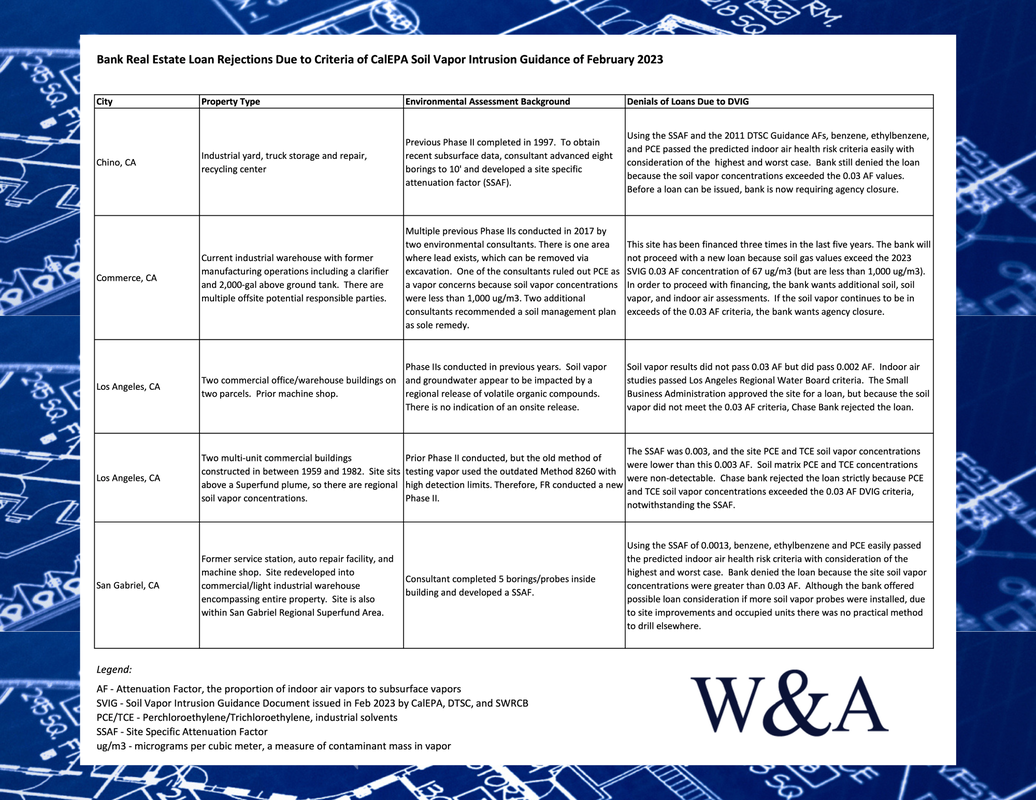
California brownfield redevelopment is dying a slow and painful death due to actions of CalEPA, DTSC, and the State Water Resource Control Board. These agencies’ Supplemental Vapor Intrusion Guidance (SVIG) of February 2023 has resulted in five cancelled bank loan offers in Winefield & Associates’ investment world. One can’t realistically buy and redevelop a blighted site without bank debt. See case studies below. Surely, this sample is a mere smidgen of the actual statewide damage. The SVIG is an underground regulation that uses outdated science, triggering many consequences detrimental to state brownfield, housing, and climate goals.

​PS – The bank loan cancellations occurred before the recent mid-tier bank failures and were strictly related to vapor intrusion criteria.
SVIG Bank Loan Rejections
File Size: 830 kb
File Type: pdf
Download File

Picture
0 Comments

National Groundwater Association Publishes Peer-Revied DTSC Attenuation Factor Study that Should Replace Outdated USEPA 2015 Study

1/11/2023

0 Comments

 
The internationally respected National Groundwater Association (NGWA) has just published a peer reviewed DTSC study concluding that the appropriate soil vapor attenuation factor (AF) for VOCs is 0.0009. This value implies a PCE soil vapor screening concentration of 2,233 ug/m3 instead of the 67 ug/m3 (0.03 AF) from USEPA’s 2015 study. Given the California-specific and recent data, why should USEPA’s 0.03 AF even remain a viable consideration? Why does SWRCB and factions within DTSC insist on avoiding best science?  Would Meredith Williams, Todd Sax, Cheryl Prowell, Nicole Fry, and Jonathan Bishop kindly help the regulated community understand why the DTSC 0.0009 screening AF is not fully embraced? Please convince this brownfield investor to stop directing resources out of state. Here is the NGWA study abstract:
The California Department of Toxic Substances Control (DTSC) gathered empirical data from sites contaminated with chlorinated volatile organic compounds (VOCs) and generated a vapor intrusion database. The database includes 52 sites across California with 213 buildings, of which, 53% are residential, and 47% are commercial / industrial (non-residential). DTSC's objective is to improve its knowledge and understanding of vapor intrusion and derive empirical attenuation factors that are representative of the climatic conditions and types of buildings commonly found in the State.

​Filtering was applied to remove data of suspect quality that were potentially affected by background sources. After filtering to 600 pairs from 32 sites across California, a subslab attenuation factor (AF) was calculated yielding a 95th percentile of 0.005. After filtering to 2926 paired measurements from 39 sites across California, a soil vapor AF was calculated yielding a 95th percentile of 0.0009. The groundwater data was not analyzed due to the small size of the dataset. The AFs from this study are similar to AFs in a California-specific study by Lahvis and Ettinger (2021). Accordingly, converging lines of evidence suggest that vapor attenuation in California is different from what is observed nationwide by the United States Environmental Protection Agency (USEPA), where an AF of 0.03 should be used for the initial screening of buildings for potential vapor intrusion exposure (USEPA, 2015).
And here is the NGA study abstract link: https://ngwa.onlinelibrary.wiley.com/doi/abs/10.1111/gwmr.12559.
Picture
0 Comments

CalEPA SWRCB NFA Issuance Rate Down Significantly Since Release of Vapor Intrusion Guidance

11/3/2022

0 Comments

 
Winefield & Associates, Inc. (W&A) has analyzed the contaminated property No Further Action (NFA) letter issuance rate for 2021, and the results are discouraging. The State Water Resources Control Board (SWRCB) closure rate is 30% less than before the California Environmental Protection Agency's Draft Vapor Intrusion Guidance Document (DVIG) was published in February 2020. California environmental agencies have always issued significantly fewer NFAs than other states, and the DVIG has made matters worse.

The SWRCB Site Cleanup Division has two primary responsibilities:
  • Protect the soil and groundwater impacted by contaminant releases; and
  • Work diligently to clean up these properties and issue No Further Action (NFA) letters.

SWRCB has a mandate to swiftly and efficiently clean up and close sites. Issuing NFAs is their responsibility and the responsibility of their nine Regional Water Quality Control Boards (Regional Boards).

In 2021, the Regional Boards issued only 488 NFAs. This is a 30% drop from the 3-year average prior to CalEPA’s DVIG issuance. 488 NFAs is an abysmal number when you compare with a state like, say, New Jersey, which has a quarter of California’s population but issues at least 10 times as many NFAs annually. (We have assumed that SWRCB issues about half the state’s NFA letters, while the Department of Toxic Substances Control and health agencies are responsible for the rest.)

Of course, many stakeholders are dependent on receiving the coveted NFA letters. Brownfield investors such as Winefield & Associates must analyze the ability to obtain NFAs before committing resources. Banks will only consider providing debt for contaminated sites if there is a path to an NFA and a remediation cost estimate can be developed. Other stakeholders include the responsible parties, those folks inhabiting buildings above contaminated sites, downgradient impacted parties, and many others. Absent cleanup standards that use best science (yes, I’m talking to you, DVIG) and an efficient report review process, the regulated community shouldn’t expect speedy cleanups any time soon from SWRCB. And absent NFAs, blighted sites cannot be converted to beneficial uses such as affordable housing.

Winefield & Associates routinely invests in brownfields outside of California, and we can unequivocally state that California is not at the forefront of assessment and remediation oversight (as CalEPA would like us to believe). When it takes six months to receive approval for Remediation Action Plans in California but three to four weeks in other states, it’s time to admit we have a problem. As SWRCB falls behind other states in its understanding of vapor mitigation risks, the pace of NFA issuance will not accelerate in the next year or two or three.

W&A would be remiss without noting that there are some sensible regulators within the CalEPA universe. The Department of Toxic Substances Control (DTSC) is actually examining and interpreting the DVIG with appropriate rigor. As of this writing, W&A is averse to acquiring California brownfields under Regional Boards’ oversight, but we are amenable to negotiating with DTSC or health agencies that are open-minded and pragmatic.

Click the link below to download and see the results of our SWRCB 2021 NFA analysis:
SWRCB 2021 NFA Analysis
File Size: 488 kb
File Type: pdf
Download File

0 Comments

Draft Vapor Intrusion Guideline Cost Comparison

3/9/2022

1 Comment

 
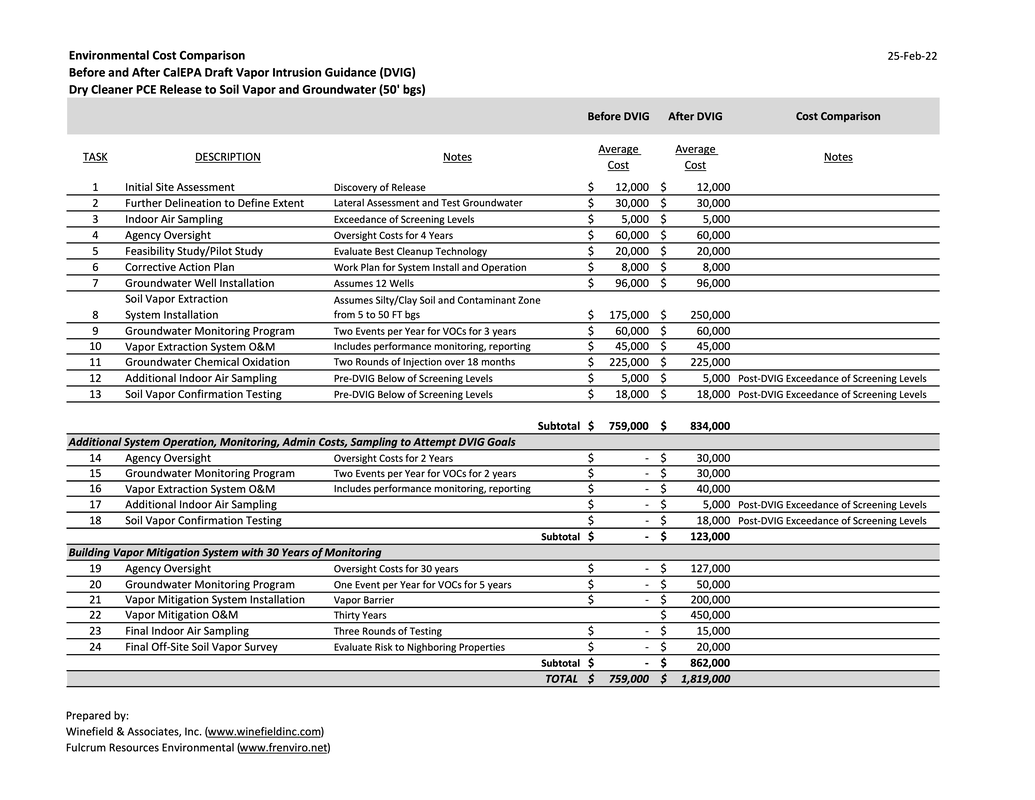
Winefield & Associates, Inc. and Fulcrum Resources Environmental have answered the question: “How much will the CalEPA Draft Vapor Intrusion Guideline (DVIG) increase dry cleaner remediation costs?” The answer is $1 million dollars per site. Assuming CalEPA retains the 0.03 attenuation factor screening value, sites will require additional remediation, vapor barriers, and extensive monitoring. An incremental cost of $1 million per site will thwart many redevelopment plans and decimate dry cleaners already impacted by COVID. Moreover, the additional environmental costs are entirely unnecessary as DTSC’s study (which CalEPA won’t release) determined that a 0.0009 AF is appropriate, which would eliminate the incremental $1 million for thousands of California properties. Reference the linked spreadsheet below for more details.
Picture
DVIG Cost Comparison
File Size: 587 kb
File Type: pdf
Download File

1 Comment
<<Previous
Long Beach, CA   |   562-618-0037   |   [email protected]
Copyright © 1997 - 2026
  • Home
  • Investment Criteria
  • About The Founder
  • Press
    • NY Times Article
    • LABJ Article
    • Propmodo Article
    • Commercial Property Executive Article
    • Western Real Estate Business Article
    • California City News Article
    • The Sacramento Bee Article
    • California Globe Article
  • Updates
  • Podcasts
  • VI Blog
  • Contact